
West Central Juvenile Release Paths
West Central Juvenile Detention Center is a multicounty secure holding facility in the Miami County Government Complex in Troy. Its stated service area includes Auglaize, Clinton, Darke, Mercer, Miami, Preble, Shelby, and Van Wert counties. That regional role explains why a Mercer County youth may be held outside Mercer County. It does not shift the youth into the county's adult detention system, and it does not make an adult jail search an appropriate way to check the youth's status.
A juvenile release can involve a return to a parent or guardian, another placement, a court-directed program, or another lawful disposition. The exact outcome must come from the order and the authorized agency record. Public adult terms such as Inactive, county-jail release, and ODRC Released do not describe this process. The Juvenile Court handling the case controls access to its proceedings and records, while the center maintains custody information subject to the rules that protect youth.
Confirm West Central Juvenile Release
Release confirmation starts with the person's lawful relationship to the youth and the specific case. A parent, guardian, attorney, or other authorized participant should use instructions already supplied by the court or detention staff. If those instructions are unavailable, contact Mercer County Juvenile Court through its official county channel and be ready to establish identity and authority. Staff may limit what can be disclosed. That limit is part of the legal process, not proof that a youth remains held or has been released.
- Identify the Mercer County juvenile case and the court responsible for it. Do not start with the adult sheriff inmate search.
- Use the official court or assigned counsel contact already associated with the case. Explain the relationship to the youth and the specific status question.
- Follow identity, guardianship, or authorization checks requested by the court or center. Do not ask a public portal to bypass those controls.
- Read the latest court order for the destination and conditions. A move to another placement is not the same as release without supervision.
- Confirm logistics directly through the authorized channel. Public sources reviewed do not establish a fixed release time or public handoff process.
The Ohio Revised Code section 2151.14 provides the juvenile detention and confidentiality context identified in the Mercer research. It supports a controlled, court-centered route. It does not create a public released-youth directory. Requests from people who are not authorized may receive no case-specific information, and no conclusion should be drawn from that response.
West Central Release Contacts
The official facility page places West Central JDC in the Miami County Government Complex in Troy. It does not place the center in Mercer County. For a Mercer youth, the research directs a release inquiry through Mercer County Juvenile Court and lawful authorized channels. Use the official facility page to confirm the institution and service area, then use the case documents or the county court's official contact route for personal information. Unsourced phone numbers, visitor rules, and release-desk hours should not be assumed.
Miami County Government Complex
Troy, Ohio
Serves Mercer County and seven other counties
Case-specific inquiries: Mercer County Juvenile Court or another authorized case channel
Ask a narrow question. An authorized caller may need to confirm whether a court order has been entered, whether the youth remains at the center, where a court-approved handoff will occur, or which agency now has responsibility. The response may depend on identity and role. A general public-record request should not be framed as a way to obtain a juvenile roster or identify all youth released during a date range.
Note: Confirm current contact details on the official court or facility page before relying on them, since the research does not supply a public release desk.
West Central Mercer Release Service
West Central is included among facilities serving Mercer County so that families and authorized participants do not make a common custody mistake. A facility need not sit inside the county to hold a youth whose case began there. The center is in Troy, in Miami County, and serves eight counties. The adult Mercer County Detention Facility, by contrast, is operated by the Mercer County Sheriff's Office for adult local custody. These are separate systems with separate access rules.
| Question | Correct channel | Channel to avoid |
|---|---|---|
| Is a Mercer youth still held? | Juvenile Court, counsel, guardian channel, or authorized center contact | Adult Mercer inmate search |
| What did the court order? | Authorized Juvenile Court case record | Adult criminal docket assumptions |
| Where did the youth go? | Authorized release or placement instruction | Public recent-release list |
| Who may receive details? | The court or custodian applies access rules | Open publication or name-based browsing |
The official Ohio law page shown below provides the juvenile detention and confidentiality context used for this distinction. Review ORC 2151.14 at Ohio Laws before interpreting the image.
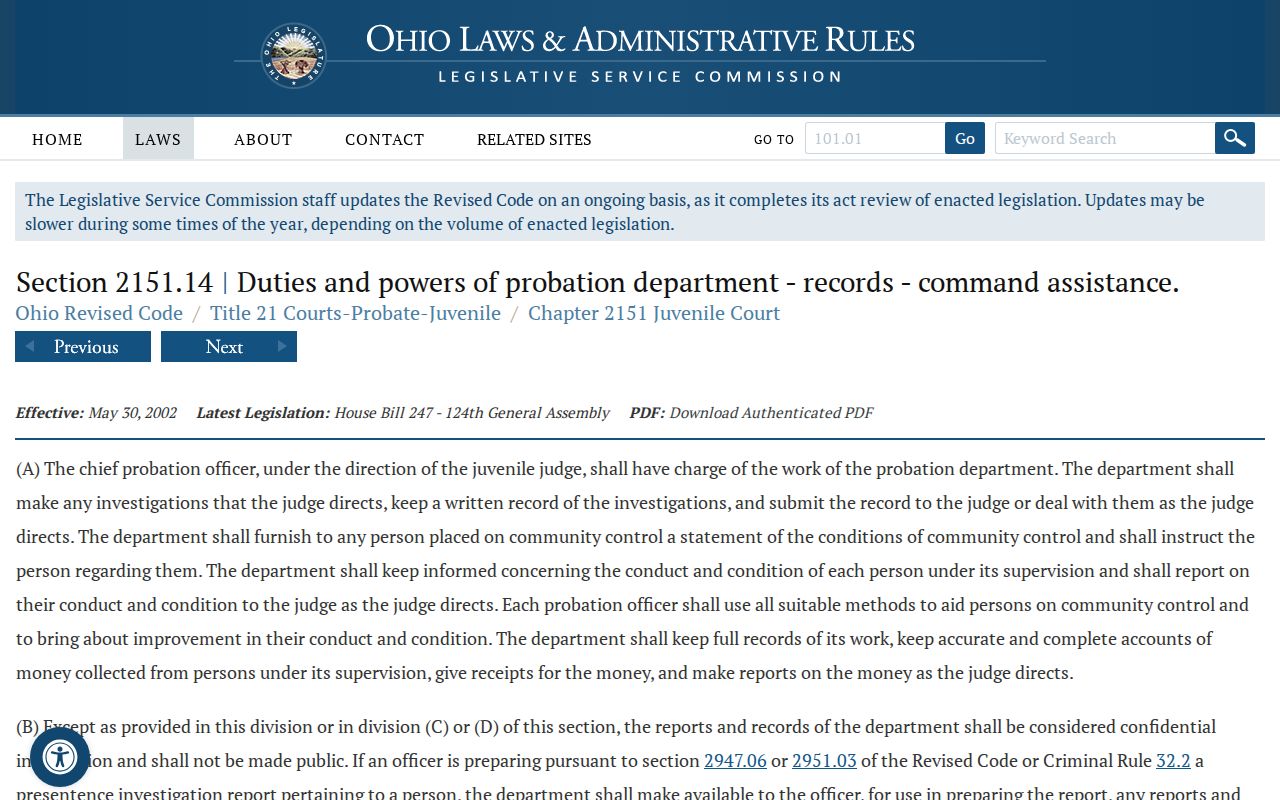
The statute view reinforces why youth custody is not presented as a public adult-style roster. The controlling court and authorized custodian remain the sources for the actual case.
West Central Adult Roster Boundary
The Mercer County Sheriff's search offers Active, Inactive, and Active - Last 24 Hours choices for its adult jail data. None is a West Central youth-release filter. Searching an adult family member's Mercer booking may be proper for that adult record, but the same technique must not be extended to a juvenile. The lack of a youth's name in the adult system says nothing about detention, release, or case history.
Ohio VINE coverage may include the Department of Youth Services, but that fact does not authorize a public juvenile-name search or override access controls. Use any notification service only through a lawful registration or case-specific path offered to an authorized person. If a notification arrives, confirm it with the case contact because a custody event may involve transfer or placement rather than an unconditional release.
- Juvenile detention
- Secure custody for a youth under juvenile court authority.
- Placement
- A court-directed setting that may follow detention and is not necessarily a return home.
- Authorized party
- A person or professional permitted to receive case information under the applicable rules.
- Confidential record
- Information whose access is restricted rather than open through an adult public roster.
West Central Release Documentation
A useful confirmation keeps three questions separate. First, did physical detention at West Central end? Second, did another placement or custodian begin? Third, what continuing terms did the Juvenile Court set? A single verbal statement may answer only one. The latest written order and the authorized facility or case contact should agree before the event is described.
Public adult release records often contain booking numbers, bond fields, photographs, and a release time. Those expectations should not be imposed on a juvenile matter. The court may restrict the existence, content, or dissemination of case details. Medical information, victim information, safety facts, and information identifying a youth can also require protection. Ask only for information the requester is permitted to receive and use it only for the case-related purpose for which access was granted.
If the case route is uncertain, begin with Mercer County's official court structure rather than a broad web search. State the youth's case number when authorized, the requester's relationship, and the precise information needed for a handoff or court appearance. Do not post the response or turn it into a public list. The Mercer County adult release resource remains relevant only for clearly adult county-jail records.
No West Central Release List
The Mercer research does not identify a public West Central recent-release feed, youth roster, booking-photo gallery, or name-search tool. That absence fits the confidentiality boundary. It should not be filled with data from commercial sites, social posts, or the adult jail. Nor should a caller ask staff to disclose a group of releases merely because adult county pages sometimes provide public logs.
A no-result finding has very little meaning here. It may reflect confidentiality, a different county's case, a new placement, a changed custodian, sealed information, or simply a system that was never meant for open lookup. Only the court and authorized participants can interpret the individual case. Keep the language narrow: the public adult tools do not establish the youth's status.