
Mercer County Projected and Actual Release Dates
A projected date is an agency's present calculation or scheduling field. An actual release date records an event that has already occurred. At the Mercer County Detention Facility, the detail page may show a Projected Out Date, but the field may be blank and the sheriff does not publish its formula. It is not the actual exit timestamp and should not be turned into a promise.
A pretrial detainee generally has no sentence-based release day. A bond payment, recognizance decision, dismissal, new order, or hold can change what happens next. A person serving a local jail sentence may have a calculated out date based on the signed sentence and credit recognized by the court. A state prisoner has a separate ODRC calculation. Those paths should never be combined into one home-made estimate.
After the event, check whether the sheriff booking is Inactive and request the actual release timestamp if precision matters. Inactive means that booking is no longer treated as active county custody. It does not explain whether the person went to the community, ODRC, another jail, federal custody, or a treatment placement.
How to Find a Mercer County Projected Release Date
Use the system that owns the sentence or custody record. Begin with firm identifiers such as the booking number, offender number, date of birth, court case, and booking date. A matching name by itself is not enough.
- Search the Mercer County jail records under Active and Inactive. Open the matching detail and record the exact label Projected Out Date, booking agency, court, bond, disposition, and prior-charge link.
- For a pending or local-sentence case, open Celina Municipal Court CaseLook or the Mercer County Common Pleas record indicated by the booking. Read the signed bond or sentence entry and any jail-time credit.
- Ask Mercer Corrections at 419-586-5753 to explain the displayed county field for that booking. Do not ask staff to endorse an independent calculation.
- For an Ohio prison sentence, use the ODRC Offender Search. Search with the prefixed six-digit offender number when known, then match the county and docket.
- Read Status together with Expected Release Date/Parole Eligibility Date, POA/PRD Date, hearing month and result, jail-time credit, and supervision fields.
- Save the retrieval date, then recheck the official record close to the expected event and after it passes.
If the sheriff field conflicts with a signed court entry, ask the court or Corrections to reconcile it. For ODRC questions, record the offender number and exact field wording. ODRC directs records questions to Central Records, P.O. Box 430, Columbus, OH 43216.
Two Mercer County Release Date Labels
Mercer's most useful date quirk is that the county and state systems do not name or mean the same thing. The jail uses Projected Out Date. ODRC uses Expected Release Date/Parole Eligibility Date. The slash in the state label is substantive because the value may reflect projected sentence expiration for one person and eligibility for Board consideration for another.
| Displayed label | How to read it | What confirms release |
|---|---|---|
| Projected Out Date | Mercer jail forecast that may be blank; no county formula is published | Inactive booking, court order, actual release record, and receiving-custodian check |
| Expected Release Date/Parole Eligibility Date | ODRC date that may be expected expiration or eligibility for parole review | Current ODRC status, hearing result when relevant, POA/PRD and supervision fields |
| Next Parole Board Hearing/Review Month | Scheduled review period, not a release day | Latest result, official minute, and refreshed custody status |
| Actual release or discharge date | Past event recorded by the custodian | Agency release record and status after the event |
The ODRC definitions page explains the state system's date and status terms.
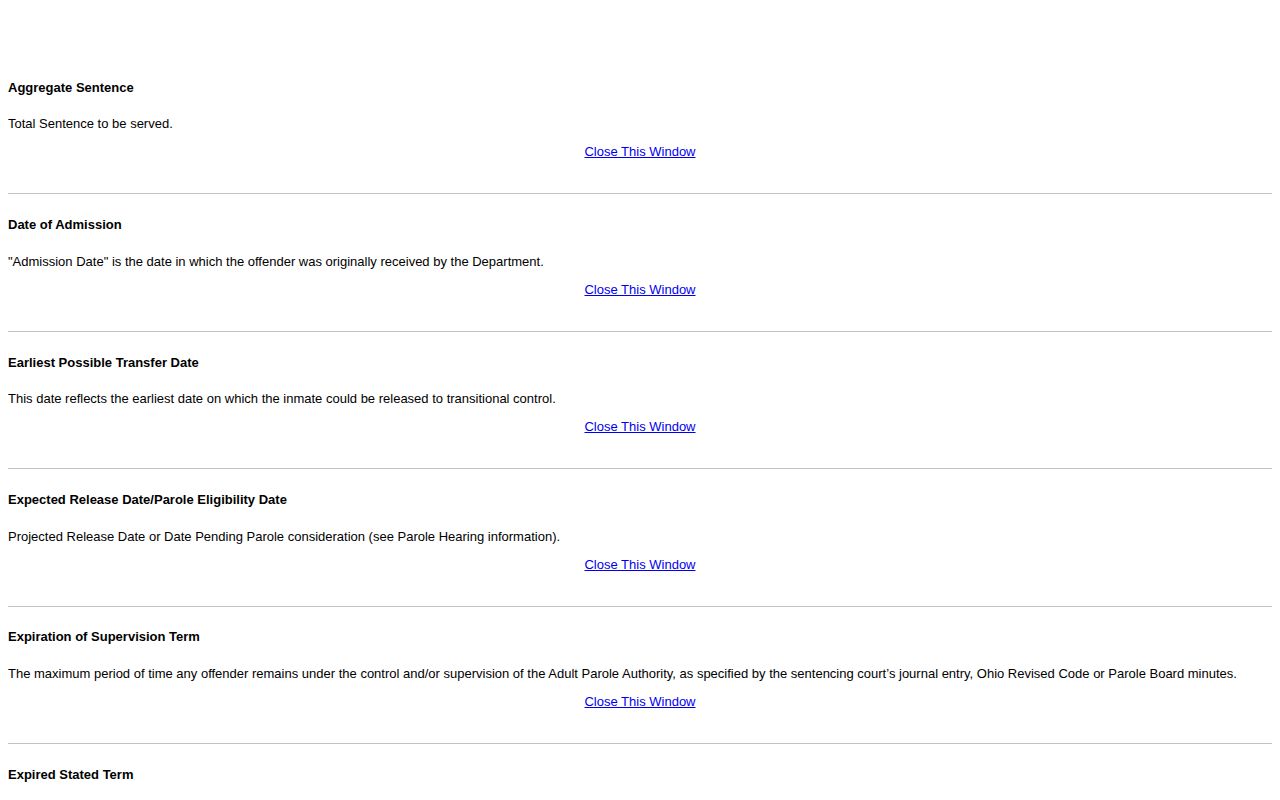
The captured definitions reinforce why a reader must retain the full combined label. If the date has passed but status still says Incarcerated, inspect the hearing section. The date may have been eligibility for review, followed by a denial or continuance.
Ohio Credits in Mercer County Release Calculations
There is no universal Ohio rule that every prisoner serves exactly 85 percent of a sentence. Ohio sentencing includes definite and indefinite terms, offense-specific mandatory provisions, older parole-eligible sentences, jail-time credit, and statutory program credits. A release date must come from ODRC's calculation for the individual sentence, not from subtracting a standard percentage.
Ohio Revised Code 2967.193 provides program and activity credit for eligible state prisoners and caps the aggregate ordinary credit described there at eight percent of the stated prison term. Eligibility classifications, exclusions, provisional recording, and final awards all matter. ORC 2967.194 and Ohio Administrative Rule 5120-2-06 address additional program-completion credit and exclusions. The rule describes an eligible completion credit of ninety days or ten percent of the stated term, whichever is less, for the specified scenarios. Mandatory, violent, and sexually oriented terms are excluded from that quoted completion provision.
Those figures are statutory limits within defined state programs, not a do-it-yourself Mercer County release formula. ODRC must decide eligibility and apply credits to its sentence calculation. Credit can be provisional before it is final, and different terms within an aggregate sentence may be treated under different legal rules.
Older indefinite and life sentences require a different reading. ORC 2967.13 sets offense-specific and sentence-specific minimum parole eligibility rules. OAC 5120:1-1-03 addresses minimum parole eligibility and older credit rules. Reaching eligibility allows Board consideration. It does not compel a grant or establish an exit date.
Mercer County Jail Date Calculation Limits
A local jail date can turn on the signed sentence, recognized jail-time credit, whether multiple days or terms run concurrently or consecutively, later court orders, bond status, and holds. The court journal is the durable source for the sentence. The jail detail is an operational record that helps readers see the facility's current forecast.
No Mercer-specific published county good-time formula was located. The research also found no published Sunday, weekend, or holiday early-release policy. Therefore, do not promise a reduction or move a date to a preferred business day. Ask Corrections to explain the field associated with the exact booking and consult the sentencing court about its own order.
The sheriff says ordinary release processing takes around twenty minutes, but that duration begins within an authorized process and is not a deadline from the moment a judge signs an order or bond is paid. Court transmission, verification, identity checks, property accounting, and holds can affect when the person actually leaves. The official material publishes no fixed release hour or public exit point.
Note: The county's process estimate explains internal handling after authorization, not the time a person will walk out of the facility.
Why Mercer County Release Dates Change
A forecast can move for legal, administrative, or custody reasons. Each change should be traced to the office responsible for it. The current status has more value than an old screenshot or a date copied without its label.
| Factor | Possible effect | Record to check |
|---|---|---|
| Jail-time credit correction | Moves the sentence calculation earlier or later | Signed court entry and ODRC sentence fields |
| Concurrent or consecutive aggregation | Changes the total controlling term | Judgment entries and ODRC calculation |
| Program credit earned, finalized, or lost | Adjusts an eligible state term within governing limits | ODRC calculation and applicable statute |
| Bond or new court order | Can authorize local release or change confinement | Current court docket and jail status |
| Detainer or receiving-agency hold | May turn a jail exit into transfer rather than community release | Release record and receiving custodian |
| Parole grant, denial, or continuance | Sets, postpones, or removes a prospective parole date | Board result, official minute, and ODRC status |
| New sentence or supervision violation | Can produce new custody or a revised controlling date | Court case, ODRC status, and agency record |
A POA/PRD Date can be useful after a parole decision, but it too should be refreshed for later changes. The Board may deny or continue review and set another month. A new case or detainer may also prevent release to the community even when the original custodian ends its hold.
Confirm a Mercer County Release Date
Near the expected event, compare the agency's current status with the court and any receiving-custodian evidence. For a county booking, check whether the record changed to Inactive, read the court's controlling order, and ask for the actual release time and destination or receiving agency if recorded. For an Ohio prison case, refresh ODRC and review supervision start, POA/PRD Date, and the latest hearing result where applicable.
When an exact county timestamp is needed, a narrow public-record request can identify the full name, approximate booking date, and local inmate number, then ask for the booking-and-release record, actual release date and time, release authority or type, and destination or receiving agency if recorded. The sheriff's request page says the form is optional, costs are quoted when records are ready, and no fixed completion deadline is promised. Ohio law calls for a response within a reasonable period.
Ohio VINE can report custody changes and send alerts for a matching county or state record. The Mercer County VINE inmate check explains the person-specific sheriff link and registration steps. An alert is a prompt to verify, not proof that no other agency took custody.
Use restrained wording in your own notes. State that the sheriff displayed a Projected Out Date when checked, that ODRC displayed Expected Release Date/Parole Eligibility Date, or that the agency later recorded release. Include the retrieval time. Avoid saying a person is “free” when the source proves only that one booking became inactive or one custodian reported release.